
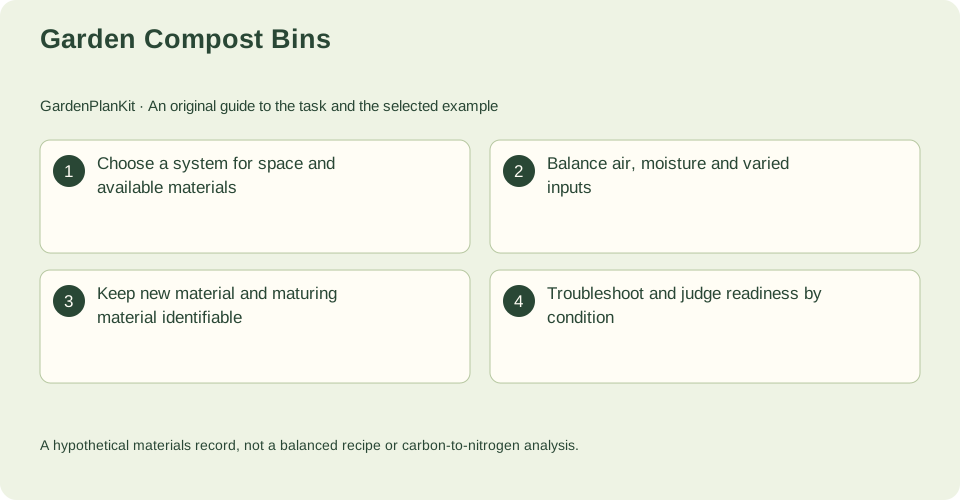
Choose a system for space and available materials
Match the bin to your constraints before you start filling it. A stationary bin suits a spot where you can add material and turn or aerate it in place. A tumbler uses the same material, air and water principles and relies on regular rotation, so consider whether you will actually rotate it and follow the manufacturer's instructions for working fill and operation. A worm bin is a different system with different inputs and management, not a smaller version of the same routine.
Material supply is part of the decision. Brown and green materials have varying composition, so the mix you can reliably gather matters more than a fixed formula. If you have plenty of dry leaves but little fresh material, or the reverse, plan how you will store and add the other component. State the limitation where it affects you: if you cannot source varied inputs, expect to manage a slower, less varied pile rather than force a recipe.
- List the space you can dedicate and whether you can turn or rotate material there.
- Identify which brown and green materials you can gather regularly and where you will store them.
- Choose stationary bin, tumbler or worm bin based on effort and intended use, then read the manufacturer's operating instructions.
Source context: Oregon State University Extension
Balance air, moisture and varied inputs
Air, water and a mix of carbon-rich and nitrogen-rich materials are the working parts of any compost routine. Check the pile rather than trusting a ratio: squeeze a handful to judge moisture, look for structure that lets air move, and notice whether the material is uniformly wet or dry. A bucket ratio is not a laboratory carbon-to-nitrogen ratio, so treat recorded volumes as a record of what you added, not a guarantee of balance.
Add material in a way you can inspect. If the pile smells bad or feels excessively wet, check aeration, food inputs and dry materials. If it is dry and inactive, assess moisture before adding more. Keep meat, dairy, oily food and pet waste out of an ordinary home food-scrap composting plan unless a specifically suitable managed process is established. Do not assume a home process sanitizes risky inputs.
- Check moisture by feel and structure before adding water or dry material.
- Add varied brown and green inputs in layers you can inspect later.
- When odors or wetness appear, check aeration, food inputs and dry material rather than adding more of the same.
Source context: Oregon State University Extension
Keep new material and maturing material identifiable
One batch actively decomposing should be distinguishable from fresh additions and from finished material. That separation is what lets you judge progress and avoid burying a maturing batch under new scraps. With a tumbler, regular rotation supports the same material, air and water principles, but you still need a way to tell which material is which.
Use position, labeling or a simple record to keep batches identifiable. A hypothetical materials record of 15 L dry leaves and 5 L fresh trimmings, totaling 20 L, is not a balanced recipe or carbon-to-nitrogen analysis. Its next check is to inspect moisture, structure and aeration, not to infer C:N from bucket counts. Apply the same discipline to your own record: note what went in, then check condition.
- Separate fresh additions from maturing material by position, label or a written record.
- Record input volumes as a log, not as proof of balance.
- At each check, inspect moisture, structure and aeration before adding more material.
Source context: Oregon State University Extension
Troubleshoot and judge readiness by condition
Judge readiness by condition, not by a calendar. Look for material that is uniform, crumbly and no longer recognizable as fresh inputs, and check that it does not smell bad or feel excessively wet. Do not promise completion in a fixed number of days, and do not assume a home process sanitizes risky inputs. If the pile is dry and inactive, assess moisture; if it smells or is too wet, check aeration, food inputs and dry materials.
Troubleshooting is a set of observations and decisions. Note what you see, change one factor, and check again. Keep the routine manageable by matching the frequency of checks to the system you chose and the materials you have.
- Inspect for uniform, crumbly condition and recognizable fresh material before calling a batch finished.
- If wet or smelly, check aeration, food inputs and dry materials.
- If dry and inactive, assess moisture before adding anything.
- Change one factor at a time and recheck condition.
Source context: Oregon State University Extension
Work through this example
A hypothetical materials record, not a balanced recipe or carbon-to-nitrogen analysis.
| Example detail | Selected value or observation |
|---|---|
| dry leaves recorded L | 15 |
| fresh trimmings recorded L | 5 |
| recorded input volume L | 20 |
| next check | Inspect moisture, structure and aeration; do not infer C:N from bucket counts. |
The supplied example is hypothetical: 15 L dry leaves plus 5 L fresh trimmings recorded as 20 L total. It is a materials record, not a balanced recipe or carbon-to-nitrogen analysis. The next check is to inspect moisture, structure and aeration; do not infer C:N from bucket counts.
Use this example to structure your own notes. Check the source conditions for the crop, method and setting.
Your action checklist
- System chosen for your space, materials and effort, with manufacturer instructions read for a tumbler.
- Brown and green inputs you can gather regularly identified and stored.
- Moisture and structure checked by feel before adding water or dry material.
- Fresh additions kept distinguishable from maturing material by position, label or record.
- Odors, wetness or dryness addressed by checking aeration, food inputs and dry materials.
Questions that come up while planning
How do I know when my compost is ready?
Judge by condition: material should be uniform and crumbly with no recognizable fresh inputs, and it should not smell bad or feel excessively wet. Do not rely on a fixed number of days.
What should I do if my compost bin smells bad or is too wet?
Check aeration, food inputs and dry materials. Keep meat, dairy, oily food and pet waste out of an ordinary home food-scrap plan unless a specifically suitable managed process is established.
Can I use a bucket ratio to balance carbon and nitrogen?
No. Brown and green materials have varying composition, and a bucket ratio is not a laboratory carbon-to-nitrogen ratio. Record volumes as a log and check moisture, structure and aeration instead.
Sources & method
Horticultural guidance is linked to its original source and regional context. Geometry and unit conversions are calculated separately. Read how we prepare and check a page.
- Do the Rot Thing: Choosing and Using a Composting SystemOregon State University Extension