
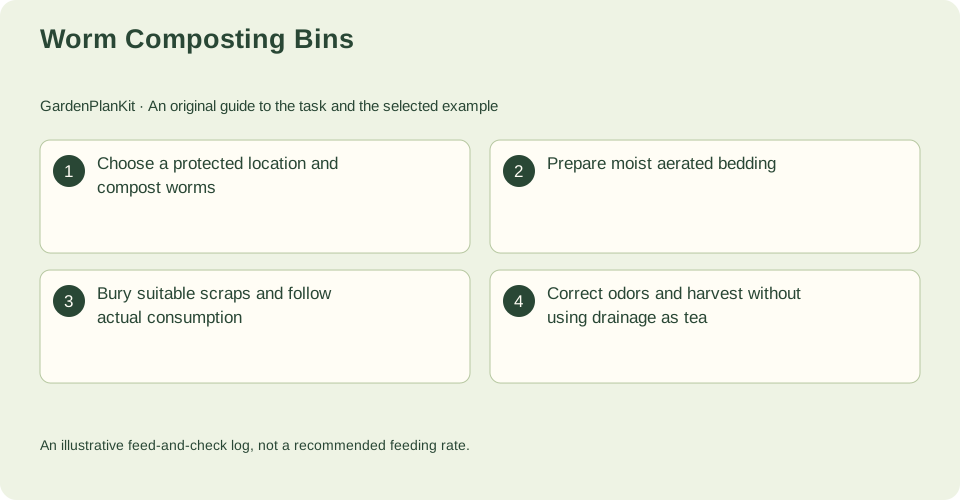
Choose a protected location and compost worms
Place the bin where it is protected from temperature extremes and pests, and where you can check it regularly. Oregon State gives 55–77 F as a useful temperature range for a protected worm bin. Treat that range as a check on your location, not a promise that any spot will stay within it. A garage, shed, or shaded spot may suit the bin better than an exposed place that swings hot or cold.
Use compost worms suited to surface dwelling, such as red wigglers. Do not assume worms sold for fishing or ordinary garden soil worms will work the same way. Before adding worms, confirm the bin has airflow and that bedding is moist. If the location cannot be kept protected, fix that first; feeding more worms will not correct an unsuitable site.
- Pick a spot sheltered from temperature extremes and pests, with room to open and check the bin.
- Confirm the bin allows airflow and has drainage.
- Obtain red wigglers or another surface-dwelling compost worm suited to a bin.
Source context: Oregon State University Extension
Prepare moist aerated bedding
Bedding gives worms a moist living space and helps the bin stay aerated. Prepare it before scraps go in, and check it by feel rather than by a fixed recipe. It should be moist throughout but not saturated. If water pools or the material feels soggy, drainage and airflow need attention. If it feels dry, moisten and mix rather than pouring water into one spot.
Keep the bedding loose enough that air can move through it. Compacted or waterlogged bedding is a common reason a bin turns unpleasant. When you add scraps, bury them in the bedding instead of leaving them exposed on the surface.
- Moisten bedding evenly and mix it so it is damp but not saturated.
- Loosen compacted bedding and confirm drainage is clear.
- Bury scraps within the bedding rather than piling them on top.
Source context: Oregon State University Extension
Bury suitable scraps and follow actual consumption
Chop suitable food scraps and bury them in the bedding. Oregon State excludes meat, fish, poultry, oils, dairy, and pet feces from feeding. Keep those out of the bin. Increase feeding only as material is consumed. The bin's actual consumption is the guide, not a set amount per week.
Check the previous addition before adding more. If scraps remain, wait or add less. Persistent uneaten food is a signal to reduce or pause feeding and inspect bedding and moisture. The hypothetical example log shows 100 g of scraps added, followed by some scraps remaining and an odor appearing. The next action is to pause new feeding and check bedding, air, and moisture before adding more. That example illustrates a decision process; it does not establish a feeding rate.
- Chop suitable scraps and bury them in the bedding.
- Exclude meat, fish, poultry, oils, dairy, and pet feces.
- Before the next feeding, check whether the previous scraps were consumed.
- If scraps remain or odor appears, pause feeding and inspect bedding, airflow, and moisture.
Source context: Oregon State University Extension
Correct odors and harvest without using drainage as tea
Persistent odors mean the bin needs correction, not more food. Reduce or pause feeding, then check bedding and moisture. Look for saturated bedding, compacted material, exposed scraps, or poor airflow. Loosen and aerate the bedding, correct moisture, and bury any exposed scraps. Resume feeding only after the bin is back in condition and material is being consumed.
Harvest finished material without treating collected drainage as a vegetable fertilizer. Oregon State advises against assuming drainage liquid is a safe vegetable fertilizer and gives no supported application rates. Manage drainage as a sign of moisture balance: if it collects, the bedding may be too wet. Do not invent a dilution or application rate.
- Pause feeding when odor persists and check bedding, airflow, and moisture.
- Loosen compacted bedding, correct saturation, and bury exposed scraps.
- Resume feeding only after the bin is corrected and scraps are being consumed.
- Do not use collected drainage as a vegetable fertilizer or assume a safe application rate.
Source context: Oregon State University Extension
Work through this example
An illustrative feed-and-check log, not a recommended feeding rate.
| Example detail | Selected value or observation |
|---|---|
| scraps added g | 100 |
| follow up | Some scraps remain and odor appears. |
| next action | Pause new feeding; check bedding, air and moisture before adding more. |
The supplied example is an illustrative feed-and-check log, not a recommended feeding rate. It records 100 g of scraps added, then some scraps remaining and an odor appearing. The stated next action is to pause new feeding and check bedding, air, and moisture before adding more. It shows how to respond to what the bin is actually consuming; it does not establish a rate, timing, or expected result.
Use this example to structure your own notes. Check the source conditions for the crop, method and setting.
Your action checklist
- Bin is in a protected location with airflow and drainage.
- Bedding is moist throughout but not saturated.
- Only suitable scraps are buried; meat, fish, poultry, oils, dairy, and pet feces are excluded.
- Previous scraps are checked before more food is added.
- Odors trigger a pause in feeding and a check of bedding, air, and moisture.
- Drainage is not treated as a vegetable fertilizer.
Questions that come up while planning
What temperature range does Oregon State give for a protected worm bin?
Oregon State gives 55–77 F as a useful temperature range for a protected worm bin. Use it to check whether your location is suitable, and protect the bin from temperature extremes.
What should I do if scraps remain and the bin smells?
Pause new feeding and check bedding, airflow, and moisture. Persistent uneaten food and odors are reasons to reduce or pause feeding and correct the bin before adding more.
Can I use drainage from the bin as fertilizer?
Do not assume collected drainage liquid is a safe vegetable fertilizer. Oregon State gives no supported application rates, so treat drainage as a moisture-balance signal rather than a product to apply.
Sources & method
Horticultural guidance is linked to its original source and regional context. Geometry and unit conversions are calculated separately. Read how we prepare and check a page.
- Composting with WormsOregon State University Extension