
Separate raising seedlings from indoor fruit production
Maryland distinguishes lighting for vegetative seedlings from lighting used to produce flowers and fruit indoors. Those are different jobs. A setup that keeps young vegetable starts growing steadily is not automatically a setup that will carry a crop to harvest under the same lamp. Decide which job you are planning before you buy or reposition anything.
This guide covers the seedling job only. If your goal is indoor fruiting, treat that as a separate question with its own equipment requirements rather than assuming the seedling lamp will scale up.
- Write down whether the light is for raising seedlings or for indoor fruit production.
- If the answer is indoor fruit, stop here and plan that setup separately.
Source context: University of Maryland Extension
Measure the footprint and read actual fixture coverage
Measure the occupied tray footprint, not just the tray size on the label. Two trays of equal area can occupy different shapes, and a fixture's stated coverage may match one shape better than the other. Check the fixture manufacturer's coverage and mounting directions directly; a wattage label or a color-temperature label alone does not establish adequate coverage or plant response.
Fluorescent mounting distances in Maryland's reference should not be copied blindly to a different LED fixture. Use the directions that came with your fixture for height and spacing.
- Measure the length and width of the area your trays actually occupy, including any gap between them.
- Compare that shape to the coverage the fixture manufacturer states.
- Record the manufacturer's mounting height and spacing directions for your specific fixture.
Source context: University of Maryland Extension
Set a timer and follow the correct mounting directions
Maryland seedling-care guidance uses 14 to 16 hours of daily supplemental lighting for vegetable seedlings. Set a timer to hold that window consistently, and mount the fixture at the height and spacing its manufacturer specifies rather than borrowing a number from a different lamp type.
Watering interacts with light setup. Keep the growing medium moist, not saturated. When the upper medium is nearly dry, water from the surface or let containers wick from a shallow pan, and make sure drainage keeps roots supplied with both water and oxygen. Saturated mix should drain. A fixed number of minutes in standing water is not a schedule; respond to the actual medium, container and plant stage.
- Set the timer for the daily lighting window your reference supports for seedlings.
- Mount the fixture per its own manufacturer's directions.
- Check medium moisture before watering and confirm containers drain freely.
Source context: University of Maryland Extension · University of Maryland Extension
Inspect growth and revise the light setup
Adjust height as seedlings grow, following the fixture directions. Watch the plants themselves: uneven growth across the tray can point to a coverage mismatch between your footprint and the fixture, while stretching suggests the light is too far away for the current stage. Revise the footprint, height or fixture placement based on what you observe rather than on labels alone.
Potting up is a separate decision from lighting. Moving a young seedling to a larger individual container when it needs room is not the same as planting outside. Maryland discusses the first true leaves as a common stage for potting up, not as proof that outdoor weather is suitable. When you do handle small seedlings, lift them by their leaves rather than their delicate stems, avoid tearing roots, firm the medium gently and water after moving them. Crop-specific root disturbance and planting-depth guidance still applies.
- Check tray growth for uneven patches or stretching and adjust fixture position accordingly.
- Pot up seedlings that need more room, handling them by the leaves.
- Keep crop-specific root and planting-depth guidance in view when transplanting.
Source context: University of Maryland Extension · University of Maryland Extension
Work through this example
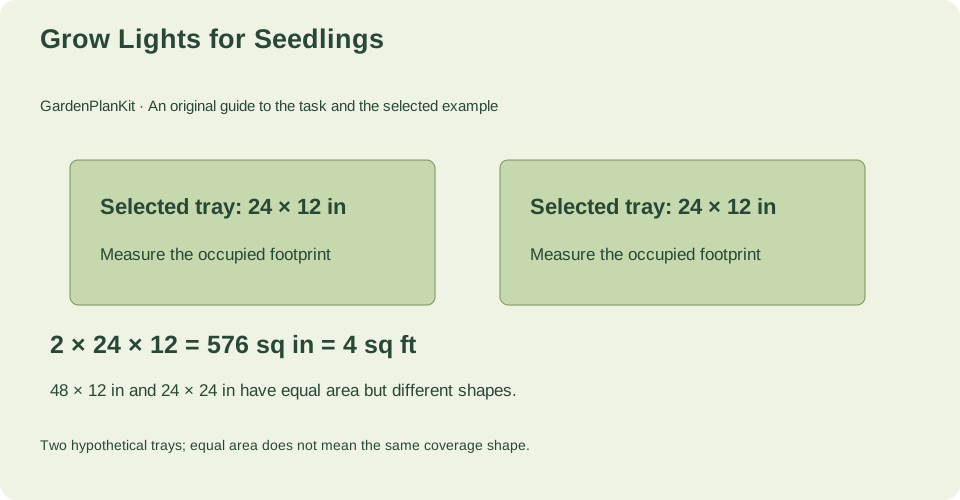
Two hypothetical trays; equal area does not mean the same coverage shape.
| Example detail | Selected value or observation |
|---|---|
| tray length in | 24 |
| tray width in | 12 |
| tray count | 2 |
| total area sq in | 576 |
| total area sq ft | 4 |
| side by side footprint in | 48 by 12 |
| alternative footprint in | 24 by 24 |
The supplied example is hypothetical: two trays each 24 by 12 inches total 576 square inches, or 4 square feet. Placed side by side they occupy a 48 by 12 inch footprint; arranged differently they could occupy 24 by 24 inches. The areas are equal, but the shapes are not, so a fixture's stated coverage may suit one arrangement better than the other. This is a geometry illustration, not a recommendation for tray layout or fixture choice.
Use this example to structure your own notes. Check the source conditions for the crop, method and setting.
Your action checklist
- Confirm the light is planned for raising seedlings, not indoor fruit production.
- Measure the occupied tray footprint, including gaps between trays.
- Compare that footprint shape to the fixture manufacturer's stated coverage.
- Set the timer to the daily seedling lighting window and mount per manufacturer directions.
- Inspect growth for uneven coverage or stretching and adjust height as seedlings grow.
Questions that come up while planning
How many hours should a grow light run for vegetable seedlings?
Maryland seedling-care guidance uses 14 to 16 hours of daily supplemental lighting for vegetable seedlings. That is a regional seedling reference, not a guarantee that every indoor crop will fruit under the same lamp.
Can I use the mounting height from a fluorescent guide on my LED fixture?
No. Maryland's reference discusses fluorescent tube types, and those mounting distances must not be copied blindly to different LED fixtures. Follow your fixture manufacturer's coverage and mounting directions.
Does a higher wattage label mean the fixture covers my trays?
Not by itself. A wattage label or color-temperature label alone does not establish adequate coverage or plant response. Measure your occupied tray footprint and compare it to the coverage the manufacturer states.
Sources & method
Horticultural guidance is linked to its original source and regional context. Geometry and unit conversions are calculated separately. Read how we prepare and check a page.
- Grow Lights for Starting Seeds IndoorsUniversity of Maryland Extension
- Care of Vegetable SeedlingsUniversity of Maryland Extension