
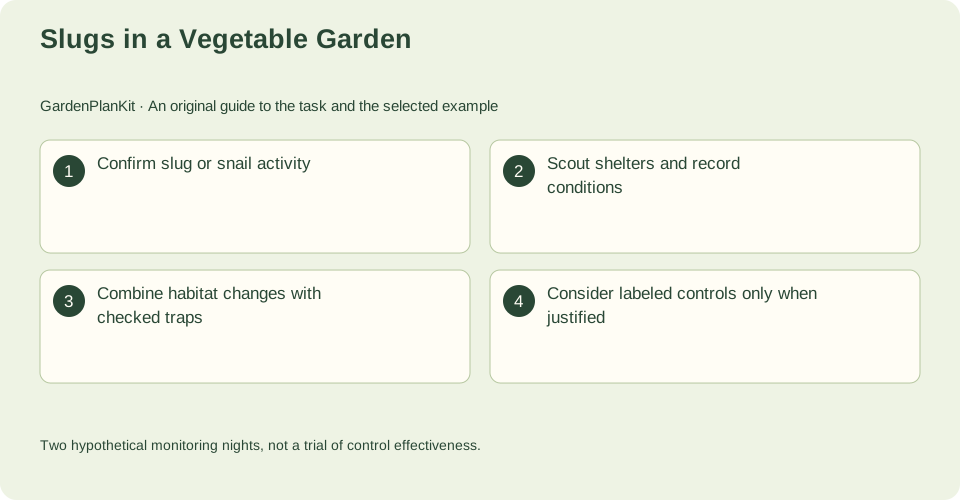
Confirm slug or snail activity
Start with evidence rather than assumption. Feeding injury alone can resemble damage from other pests, so look for the animal, the injury pattern and slime trails together. Because slugs and snails feed mostly at night, a daytime check may miss the animals even when damage is present.
Choose a search time that fits the source description and inspect the plants and the ground nearby. Record what you saw and where, so later observations can be compared on equal terms. If you find no animals, injury or trails, treat the question as unresolved rather than starting a control measure.
- Inspect damaged plants for the animal, feeding injury and slime trails.
- Check after dark or at night, when slugs and snails feed mostly.
- Write down what you found, where, and under what conditions.
Source context: University of California Statewide IPM
Scout shelters and record conditions
Slugs and snails shelter in moist, protected locations. Scout those places deliberately: look under and around objects and in damp, covered spots near the vegetable beds. Note the moisture and shelter you observe, because those conditions are what you will later manage.
Keep a simple record for each scouting visit: date, search time, weather, how thoroughly you searched, and the number of animals seen. The supplied example shows why this matters. It describes two hypothetical monitoring nights with three slugs observed on night A and one on night B. That is not a trial of control effectiveness. Different weather and different search effort can change observations, so a lower count on one night does not by itself show that anything worked.
- Search moist, protected shelter spots near the beds.
- Record date, time, weather, search effort and animals seen.
- Compare counts only when weather and search effort are similar.
Source context: University of California Statewide IPM
Combine habitat changes with checked traps
UC IPM recommends combining monitoring, removal of unnecessary hiding places, hand collection or inspected shelter traps, and moisture management that still meets crop needs. These are complementary actions, not a single fix. Removing unnecessary hiding places reduces shelter, while hand collection or shelter traps let you remove animals you find.
A trap only helps when it is regularly checked. An unchecked trap is just another sheltered spot. Set a checking routine and record what each check finds, then adjust where you place traps based on your scouting notes. Manage moisture without pushing the garden below what the crops need; the source ties moisture management to crop needs rather than to drying everything out.
- Remove unnecessary hiding places identified during scouting.
- Hand-collect animals or set shelter traps, and check them on a regular routine.
- Manage moisture while still meeting crop needs.
- Log each trap check and use the results to adjust placement.
Source context: University of California Statewide IPM
Consider labeled controls only when justified
If monitoring, habitat changes, collection and checked traps have not addressed the problem, a pesticide bait may be considered. The actual product label and its crop and site restrictions govern use. Read the label for the specific crop and site before buying or applying anything.
Do not use household salt, homemade pesticide recipes or unsupported bait doses. Acknowledge pets and wildlife in product decisions, and follow the label rather than any general rule. The label, not this guide, is the authority on whether and how a product may be used.
- Confirm the product label lists your crop and site.
- Read the label directions and restrictions before use.
- Account for pets and wildlife when deciding whether a product is appropriate.
Source context: University of California Statewide IPM
Work through this example
Two hypothetical monitoring nights, not a trial of control effectiveness.
| Example detail | Selected value or observation |
|---|---|
| night A slugs observed | 3 |
| night B slugs observed | 1 |
| comparison limit | Different weather and search effort can change observations. |
The supplied example is hypothetical: two monitoring nights with three slugs observed on night A and one on night B. It is not a trial of control effectiveness. Because different weather and search effort can change observations, the two counts should not be read as proof that any measure reduced slugs.
Use this example to structure your own notes. Check the source conditions for the crop, method and setting.
Your action checklist
- I confirmed the animal, feeding injury and slime trails before treating.
- I scouted moist, protected shelters and recorded conditions.
- My monitoring notes include date, time, weather and search effort.
- Traps are checked on a regular routine, not left unattended.
- Any product I consider lists my crop and site on its label.
Questions that come up while planning
How do I know slugs rather than another pest are damaging my vegetables?
Look for the animal, feeding injury and slime trails together. UC IPM notes slugs and snails feed mostly at night, so check then as well as in daylight before deciding on treatment.
Why did my slug count drop from one night to the next?
A lower count does not prove a control worked. Different weather and different search effort can change observations, so compare counts only when conditions and effort are similar.
Can I use salt or a homemade bait recipe?
No. This guide does not give household salt, homemade pesticide recipes or unsupported bait doses. Where a bait is considered, the product label and its crop and site restrictions govern use.
Sources & method
Horticultural guidance is linked to its original source and regional context. Geometry and unit conversions are calculated separately. Read how we prepare and check a page.
- Snails and SlugsUniversity of California Statewide IPM