
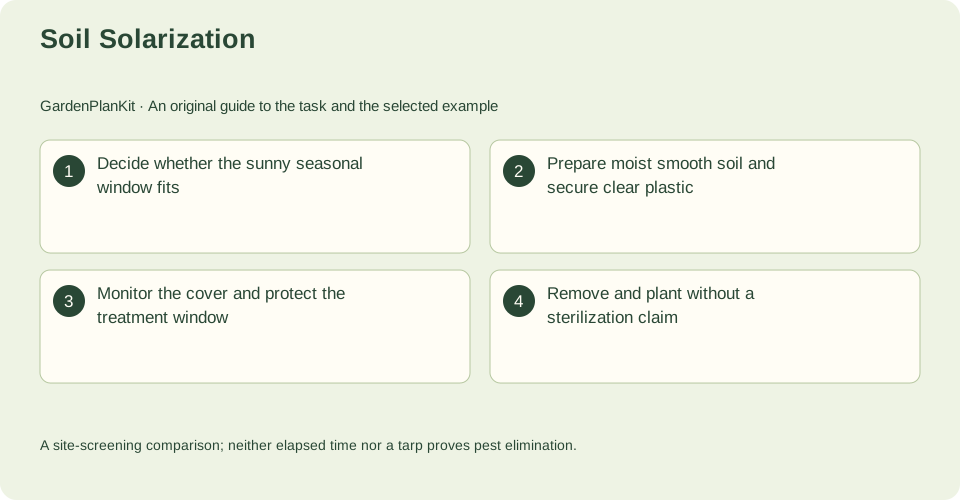
Decide whether the sunny seasonal window fits
Solarization depends on warm, sunny conditions and moist soil under clear plastic, so start by judging the site rather than the calendar alone. A hot, sunny spot with prepared, moist soil and room for a secure transparent cover is the basic fit. A shaded or cool site is a reason to reconsider solarization instead of copying a summer timetable from another region.
UC guidance commonly describes 4 to 6 weeks during hot summer weather, with longer periods sometimes needed. That guidance is a California reference and should not be generalized to shaded sites or every climate. Treat any interval as a planning input, not proof that pests are gone.
Clear plastic is central to the heating setup. Opaque tarping is a different process called occultation, so do not substitute a dark tarp and expect the same treatment. If your plan depends on an opaque cover, you are planning a different method.
- Check whether the intended bed receives direct sun through the warm season you plan to use.
- Confirm the soil can be moistened and smoothed before covering.
- Choose clear transparent plastic rather than an opaque tarp for this method.
- Write down the treatment interval you intend to use and where that guidance comes from.
Source context: University of California Statewide IPM
Prepare moist smooth soil and secure clear plastic
Smooth and moisten the soil before laying the clear plastic. A smooth surface helps the plastic sit tightly, and moisture is part of the heating setup described by UC IPM. Fit the plastic closely and secure it so wind cannot lift or flap it.
Repair holes as you find them. Tears and loose edges let heat escape and weaken the treatment. The cover should stay intact for the planned window, so check the edges and surface after installation rather than assuming the job is finished once the plastic is down.
- Clear and smooth the bed surface before wetting it.
- Moisten the soil, then fit clear plastic tightly over the prepared area.
- Secure all edges so the cover stays in contact with the soil.
- Inspect for holes and repair them promptly.
Source context: University of California Statewide IPM
Monitor the cover and protect the treatment window
During the treatment window, watch the cover for tears, lifted edges and other damage. Repair holes when you find them so the setup stays as intended. Keep a simple record of when the cover went down and when you checked it, because a covered calendar interval alone is not proof of pest elimination.
The process affects many pests and weed seeds but not all equally. Plan for uneven results rather than a uniform outcome. If the site turns out to be shaded or cool, reconsider solarization rather than extending a summer timetable by default.
- Inspect the plastic regularly for holes and loose edges.
- Repair damage as soon as it appears.
- Record the cover date and each inspection.
- Reassess the site if sun or warmth does not match the plan.
Source context: University of California Statewide IPM
Remove and plant without a sterilization claim
When you remove the cover, avoid bringing deep untreated soil to the surface afterward. Disturbing deeper soil can undo part of the benefit at the surface you treated. A covered interval alone is not proof that a bed is ready for a particular crop, so check the bed and your crop plan before planting.
Solarization does not sterilize all soil permanently. Describe the result as a treatment that may reduce many pests and weed seeds, not as guaranteed elimination. The hypothetical site comparison illustrates the decision: site A is hot, sunny, moist prepared soil with a secure transparent cover, while site B is shaded or cool and should prompt reconsideration rather than a copied summer timetable. Neither elapsed time nor a tarp proves pest elimination.
- Remove the plastic carefully and avoid turning deep untreated soil to the surface.
- Check the bed against your crop plan before planting.
- Keep expectations bounded: reduced pests and weed seeds, not sterilization.
Source context: University of California Statewide IPM
Work through this example
A site-screening comparison; neither elapsed time nor a tarp proves pest elimination.
| Example detail | Selected value or observation |
|---|---|
| site A | Hot, sunny, moist prepared soil with a secure transparent cover. |
| site B | Shaded or cool site: reconsider solarization rather than copying a summer timetable. |
| distinct method | Opaque tarping is occultation, not the same heating setup. |
The supplied example is hypothetical and is a site-screening comparison, not a measured result. Site A has hot, sunny, moist prepared soil with a secure transparent cover. Site B is shaded or cool, so the right move is to reconsider solarization rather than copy a summer timetable. Opaque tarping is occultation, a distinct method. Neither elapsed time nor a tarp proves pest elimination.
Use this example to structure your own notes. Check the source conditions for the crop, method and setting.
Your action checklist
- Site receives direct sun during the planned warm season.
- Soil is moistened and smoothed before covering.
- Clear transparent plastic is fitted tightly and secured.
- Holes and lifted edges are repaired during the treatment window.
- Cover date and inspections are recorded.
- Deep untreated soil is not brought to the surface after removal.
Questions that come up while planning
How long does soil solarization take?
UC guidance commonly describes 4 to 6 weeks during hot summer weather, with longer periods sometimes needed. That is a California reference and should not be generalized to shaded sites or every climate. A covered interval alone is not proof of pest elimination.
Is an opaque tarp the same as solarization?
No. Solarization uses tightly fitted transparent plastic over moist soil in warm, sunny conditions. Opaque tarping is a different process called occultation.
Does solarization sterilize the soil?
No. It affects many pests and weed seeds but not all equally, and it does not sterilize all soil permanently. Avoid bringing deep untreated soil to the surface afterward.
Sources & method
Horticultural guidance is linked to its original source and regional context. Geometry and unit conversions are calculated separately. Read how we prepare and check a page.
- Soil Solarization for Gardens and LandscapesUniversity of California Statewide IPM