
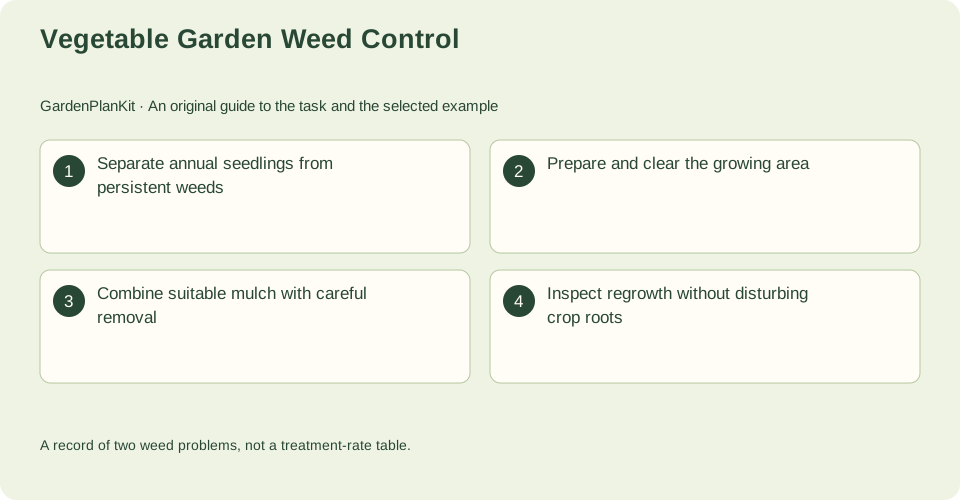
Separate annual seedlings from persistent weeds
Before pulling anything, look at what is growing and how it is rooted. Annual weeds typically arrive as seedlings and complete their life cycle within a season; removing them before they flower and produce seed prevents the next generation. Persistent perennial weeds regrow from surviving roots or underground structures, so pulling the top growth may not end the problem. Record what you see, because the identification drives every later step.
A simple patch record keeps the two problems distinct. Note the location, your identification, the action taken and the next observation you plan to make. The supplied example is hypothetical: patch A holds young annual seedlings to remove before seed set, and patch B holds persistent perennial regrowth to inspect for surviving roots and repeat follow-up. It is a record of two weed problems, not a treatment-rate table.
- Walk the bed and note each weed patch by location.
- Decide whether each patch looks like annual seedlings or persistent perennial growth.
- Write the identification, planned action and next observation in your record.
Source context: University of California Statewide IPM
Prepare and clear the growing area
For a new planting area, UC IPM describes watering to encourage a flush of weed seedlings, then clearing them before crop planting. This lets you deal with seedlings on open ground rather than among established crops. Clear the flush thoroughly, and note where regrowth appears so the follow-up is targeted.
After clearing, mulch and low-disturbance follow-up help avoid continually exposing more seed. Digging or turning repeatedly can bring fresh weed seed to the surface, so favor actions that disturb the soil only where needed. Landscape herbicide uses do not automatically apply to edible vegetable beds; this guide stays with physical and cultural actions and does not supply product doses or food-crop permissions.
- Water the new area to encourage a flush of weed seedlings.
- Clear the seedlings before planting crops.
- Apply suitable mulch and keep later soil disturbance low and targeted.
Source context: University of California Statewide IPM
Combine suitable mulch with careful removal
Mulch is one part of the plan, not a substitute for removal. UC IPM recommends combining prevention, suitable mulches and physical removal rather than relying on one action. Choose a mulch that suits the bed and the crop stage, and keep it clear of stems where that matters for the planting. Where weeds emerge through or around mulch, remove them while they are small and before they flower.
Careful removal means working around crop roots. Hand-pull shallow seedlings, and for persistent perennials loosen and lift rather than yanking, so you can see what root or underground structure comes out. If a root breaks, mark the spot for follow-up inspection instead of assuming the weed is gone.
- Apply a suitable mulch around the bed, keeping it clear of crop stems.
- Remove small weeds by hand before they flower.
- For persistent perennials, loosen and lift to check what root material is removed.
- Mark any spot where root material broke off for later inspection.
Source context: University of California Statewide IPM
Inspect regrowth without disturbing crop roots
Follow-up is where persistent weeds are actually managed. Return to the recorded patches and inspect for regrowth, especially where roots or underground structures survived. Check before new growth flowers and produces seed. Compare what you see with your record so the next action responds to the actual problem rather than a guess.
Inspect gently. Probing deeply around established crops can damage the roots you are trying to protect, so work at the surface where possible and remove only what you can lift cleanly. Update the record with the date, what regrew and the next observation. Repeat follow-up as regrowth appears; the hypothetical patch B example shows this loop, not a guaranteed schedule.
- Revisit recorded patches and check for regrowth.
- Remove regrowth before it flowers and produces seed.
- Work at the surface near crop roots and avoid deep probing.
- Update the record with the observation and the next check.
Source context: University of California Statewide IPM
Work through this example
A record of two weed problems, not a treatment-rate table.
| Example detail | Selected value or observation |
|---|---|
| patch A | Young annual seedlings: remove before seed set. |
| patch B | Persistent perennial regrowth: inspect surviving roots and repeat follow-up. |
| record | Location, identification, action and the next observation. |
The supplied example is hypothetical and is a record of two weed problems, not a treatment-rate table. Patch A shows young annual seedlings to remove before seed set; patch B shows persistent perennial regrowth to inspect for surviving roots and repeat follow-up. The record fields are location, identification, action and the next observation. No rates, timings or results are implied.
Use this example to structure your own notes. Check the source conditions for the crop, method and setting.
Your action checklist
- Each weed patch is identified as annual seedlings or persistent perennial growth.
- Young weeds are removed before they flower and produce seed.
- A new area is watered for a flush of seedlings and cleared before crop planting.
- Suitable mulch is applied and later soil disturbance is kept low.
- Recorded patches are inspected for regrowth, with root breaks marked for follow-up.
Questions that come up while planning
Should I pull perennial weeds the same way as annual seedlings?
No. Annual seedlings can usually be removed before they flower and produce seed. Persistent perennials also require attention to surviving roots or underground structures, so loosen and lift them and plan follow-up inspection where root material remains.
Does mulch alone control weeds in a vegetable bed?
UC IPM recommends combining prevention, suitable mulches and physical removal rather than relying on one action. Treat mulch as one part of the plan and keep removing weeds that emerge before they set seed.
Can I use landscape herbicide guidance in my vegetable bed?
Landscape herbicide uses do not automatically apply to edible vegetable beds. This guide emphasizes physical and cultural actions and does not provide product doses or food-crop permissions.
Sources & method
Horticultural guidance is linked to its original source and regional context. Geometry and unit conversions are calculated separately. Read how we prepare and check a page.
- Weed Management in LandscapesUniversity of California Statewide IPM